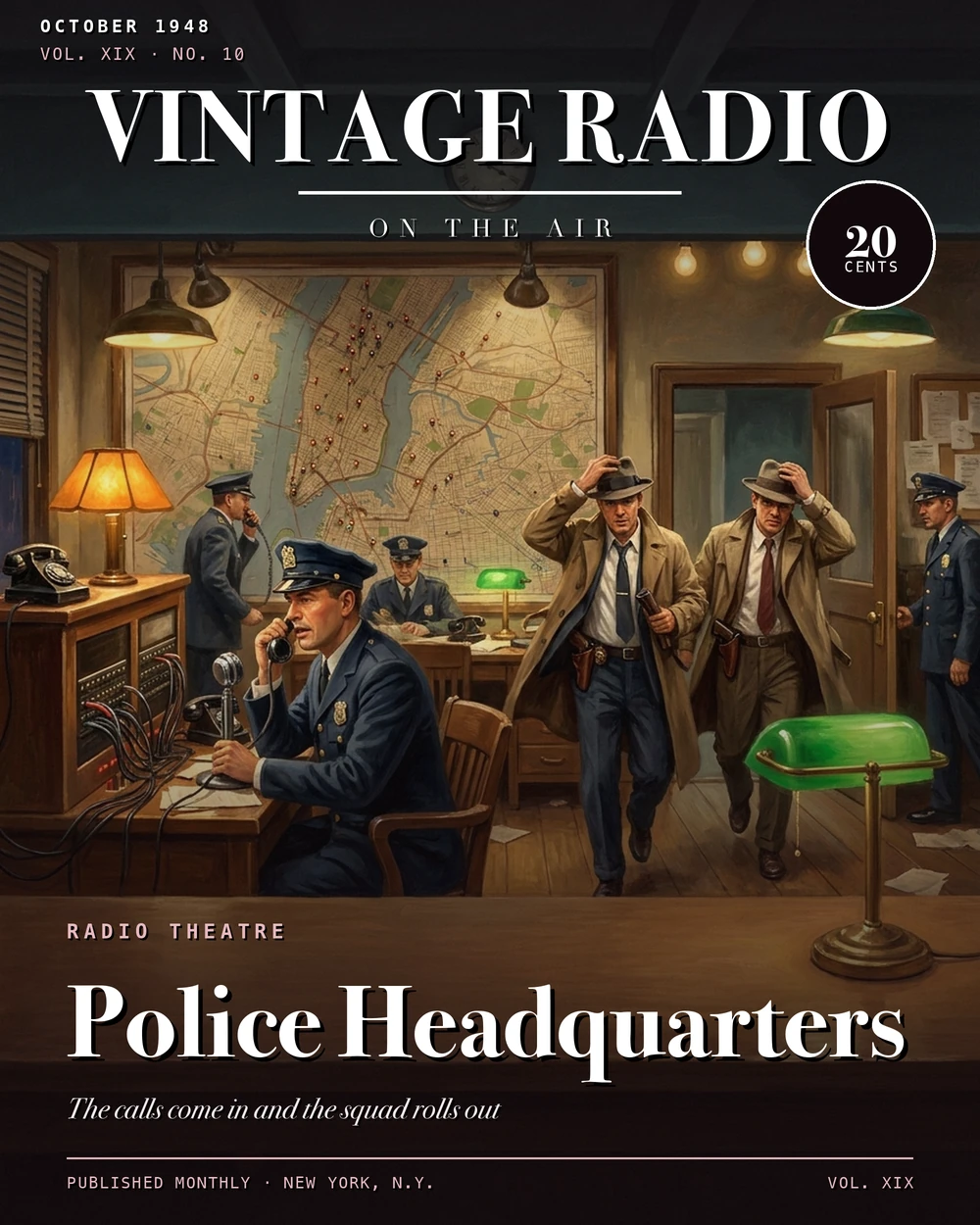
Police Headquarters
Getting There First
What sets Police Headquarters apart from nearly everything else in the Crime-Detective catalog is its date: 1932. That puts it on the air roughly two decades before Dragnet arrived to define what a radio police procedural was supposed to sound like. The format that Jack Webb would later sharpen into something iconic — the citizen's call, the investigation, the collar — was already running on transcription disks being shipped to NBC West Coast affiliate stations before most of the medium had figured out what drama even meant in an audio context. That's not a small thing.
The show was produced by Bruce Eells Associates (also credited as Bruce Eells Productions) and distributed through the Broadcasters Program Syndicate, making it one of the more sophisticated examples of radio program syndication from the early 1930s. The major networks still refused to air pre-recorded material at that point, so Bruce Eells cut acetate transcription disks and physically mailed copies to subscribing stations — a logistically demanding approach that was ahead of industry norms and made the show's reach possible in the first place.
The Format and How It Worked
Every episode followed the same basic shape: a citizen reports a crime by telephone, police respond to the scene, investigators follow the leads, and the perpetrator is caught. Simple, economical, and it ran in about 12.5 minutes of actual drama time. The total episode length was roughly 15 minutes, with the opening portion given over to music so the local station announcer could deliver commercials before the story started. That left the writers and cast a tight window to set up a crime, build some tension, and close the case.
Given that constraint, the show's reliance on realistic dialogue and police-procedural plotting rather than melodrama was a smart choice. There was no time for long speeches or baroque twists — you needed a clean line from crime to resolution, and the scripts held to it. Each episode was self-contained, so a new listener could drop in without backstory and follow the case from the opening phone call to the wrap.
The cases themselves were drawn from actual police incidents, though the broadcast versions always ended in a successful solve — regardless of what happened in reality. That was a deliberate editorial decision, and it points toward something interesting about what the show was and wasn't trying to do. It wasn't a documentary. It was using the texture of real police work to make the drama feel grounded, while still delivering the satisfying resolution that an audience tuning in for a crime story expected.
Episodes Worth Noting
The surviving episode titles give a decent cross-section of the range the show worked across. Some are straightforward procedural premises: "Infiltrating the Mob," "Deadly Poker Game," "Hot Bonds." Others lean toward moral complexity: "Conscience," "Paid in Full" — the latter being a case where the guilty party is known but can't be legally pinned with the crime, which is a notably un-tidy ending for a show that otherwise always delivered the collar. "Chained" and "Retired" suggest character-focused stories, while "Andy Green Killing" and "Mrs Smallwood Killed" have the flat, file-folder quality of actual case designations.
The more vivid episode premises come through in a few surviving plot descriptions. "Stolen Brain" involves a professor's body going missing and the brain being held for a $35,000 ransom — lurid even by the standards of 1932 crime fiction. "The IOU Murder" presents a mansion killing staged to look like a suicide. These aren't shy about their pulp instincts, which kept the show watchable even as it stayed within the procedural format.
Thirty-seven of the original 39 episodes survive, which is a strong preservation rate for a syndicated transcription series from this period.
The Ensemble and What We Don't Know
Police Headquarters featured an ensemble cast that included seasoned detectives and rookie officers — a structural choice that let the show explore the precinct as a workplace rather than just a backdrop for a single hero detective. That's actually a more modern instinct than a lot of contemporaneous crime radio, which tended to center everything on one charismatic lead.
The frustrating part is that cast documentation is almost entirely gone. Very little survives to identify the actors who performed in the series. For a show this historically significant — and one with 37 episodes in circulation — the anonymity of its performers is a real gap. The voices are there in the recordings; the names attached to them largely aren't.
What It Set Up
Police Headquarters didn't invent every convention it used, but it assembled them into a coherent format early enough that it's reasonably described as one of radio's first docu-style police dramas. The citizen-triggers-the-dragnet structure, the precinct as the center of gravity, the grounding in real case material, the ensemble of officers rather than a lone-wolf investigator — all of these showed up here in 1932 and showed up again, refined and amplified, in the procedurals that defined the genre in the 1940s and 1950s. No source draws a direct documented line from Police Headquarters to specific later shows, but the structural resemblance to what Dragnet would eventually become is plain enough that the comparison gets made regularly by OTR historians.
The show also demonstrates something about early syndication that's worth acknowledging. Getting a drama series distributed nationally in 1932, without network carriage and through physical disk shipment to affiliate stations, required real infrastructure and real investment. Bruce Eells Associates built that infrastructure, and the fact that 37 episodes survived to be catalogued means the effort was durable in ways the people involved probably didn't anticipate.